
Pavements, traditionally, are designed for pedestrians to walk along. The pavement design handbook says:-
1. They should be wide enough for at least one person, and ideally for a pushchair or a wheelchair.
2. They should be level, without trip hazards and free of obstacles and instructions.
3..They should ahave a kerb which encourages road vehicles to stay on the road.
4. They should provide a continuous path without breaks or sudden termination.
5. Shops and restaurants should not cross the line and spill out of their premises into the pavement.
Vietnam has no such rules.
Paving slabs are broken or missing, there are holes in the pavement and there are multiple trip hazards.
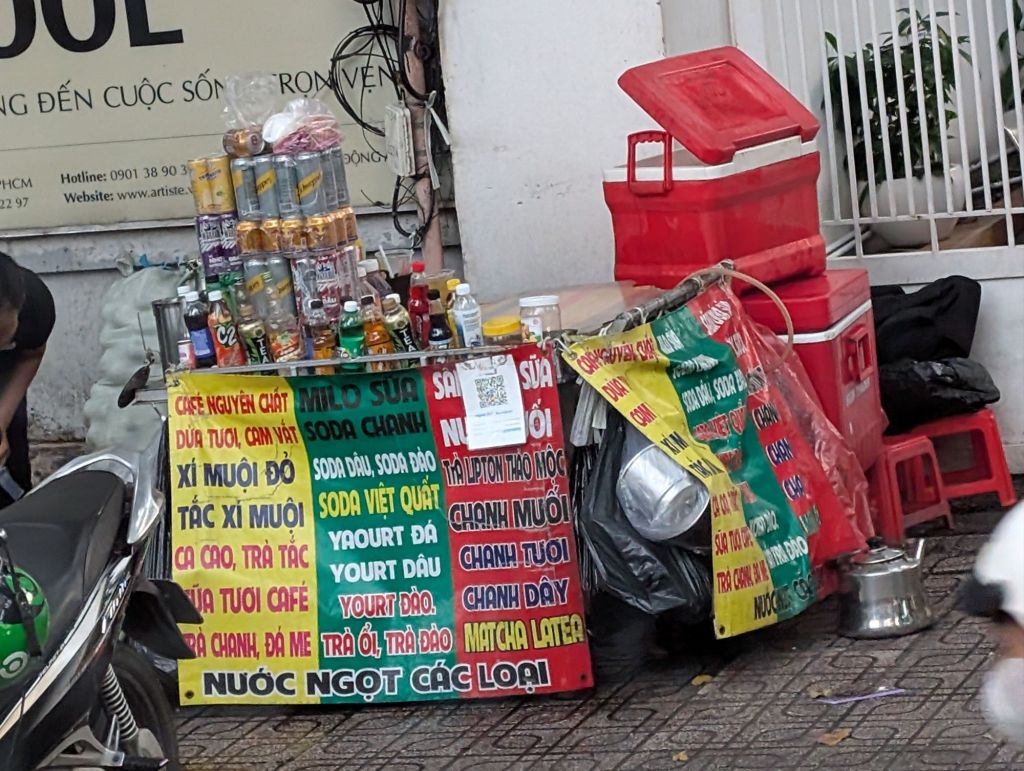
The pavements are simply not designed for walking along. They are there for street food sellers, bags of rubbish, piles of bricks, shop displays or simply people hanging out on plastic chairs drinking coffee or smoking a cigarette.
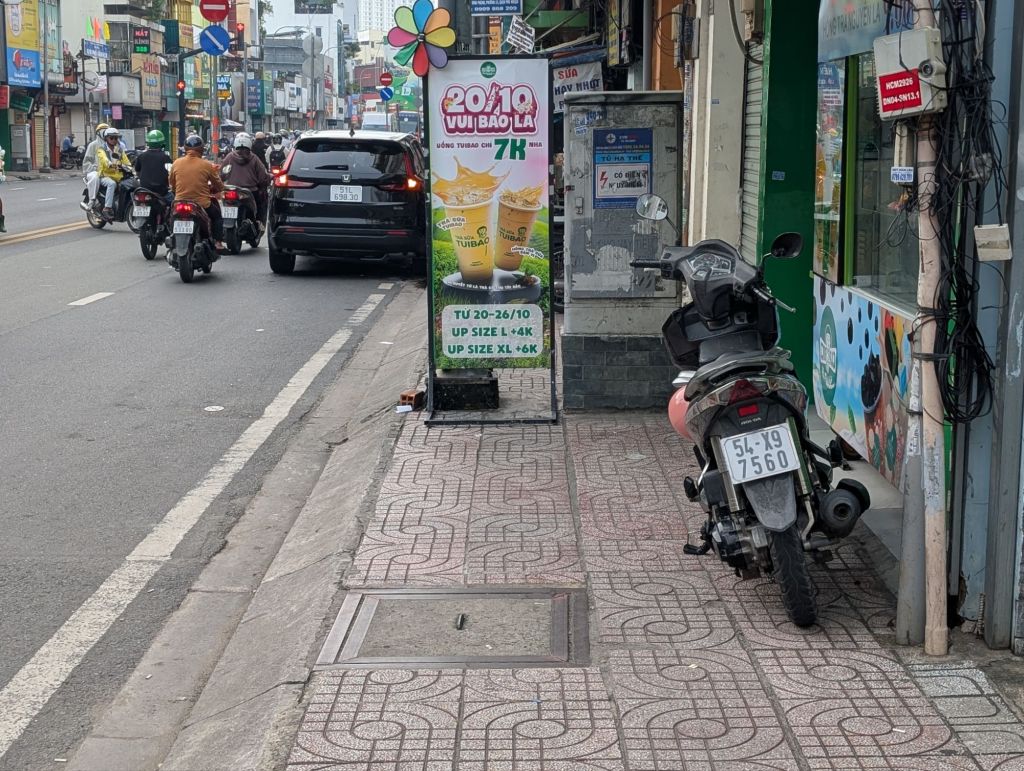
But most of all they are there for the scooters and motorbikes. Yes they ride in swarms on the road, but they park up on the pavements, maybe for the day, or maybe for a few minutes to buy something. They form a queue on the pavement for food.
None of the pavements have kerbs as we know them, rather they have nice slopes down to the road to make them easier for the scooter and motirbikes to mount.
Just in case a pavement becomes accidentally accessible, there will be a car or lorry parked on it, or some sort of electrical unit constructed on it.
At some points the pavement just stops – as if it has become weary of trying to be a pavement and in desperation simply given up.
So it is naive and hazardous to assume a pavement is for walking. And it is impossible to walk any distance without having to step off into the road.
So that is what we do. And after a while, we simply concede defeat and stay walking along the road. It feels safer and easier.
The swarms of scooters and motorbikes avoid us. So do the cars. As they are using the pavement, they accept that we pedestrians may use the road. An amicable compromise.
As in life, sometimes clear and agreed boundaries of demarcation are helpful. But at other times compromise and co-existance are better and more flexible. Vietnamese pavement and road users have opted for amicable shared space.
Maybe that’s a lesson for us all.
 Unwrapping The World
Maybe poorer 3rd world countries have populations that have learnt to adapt to what they have and are possibly happier than their more affluent brothers and sisters of the 1st world.
I think there is a certain beauty in chaos. The culture and country is rich in colour and tradition and the people who have had to deal with so much, as history tells us, have still survived and retained this unique character.
I enjoy your writing please continue . I look forward to reading more posts.
Thanks for your comments which I agree with ! I was stuck by the life, colour and vibrancy just a couple of generations after the war and depression. Some countries in eastern Europe have the same feel – although more monochrome and less frenetic !